You're paying $500+/month for social media tools, image generators, email senders, and web scrapers separately. Here's how one API key replaces them all.
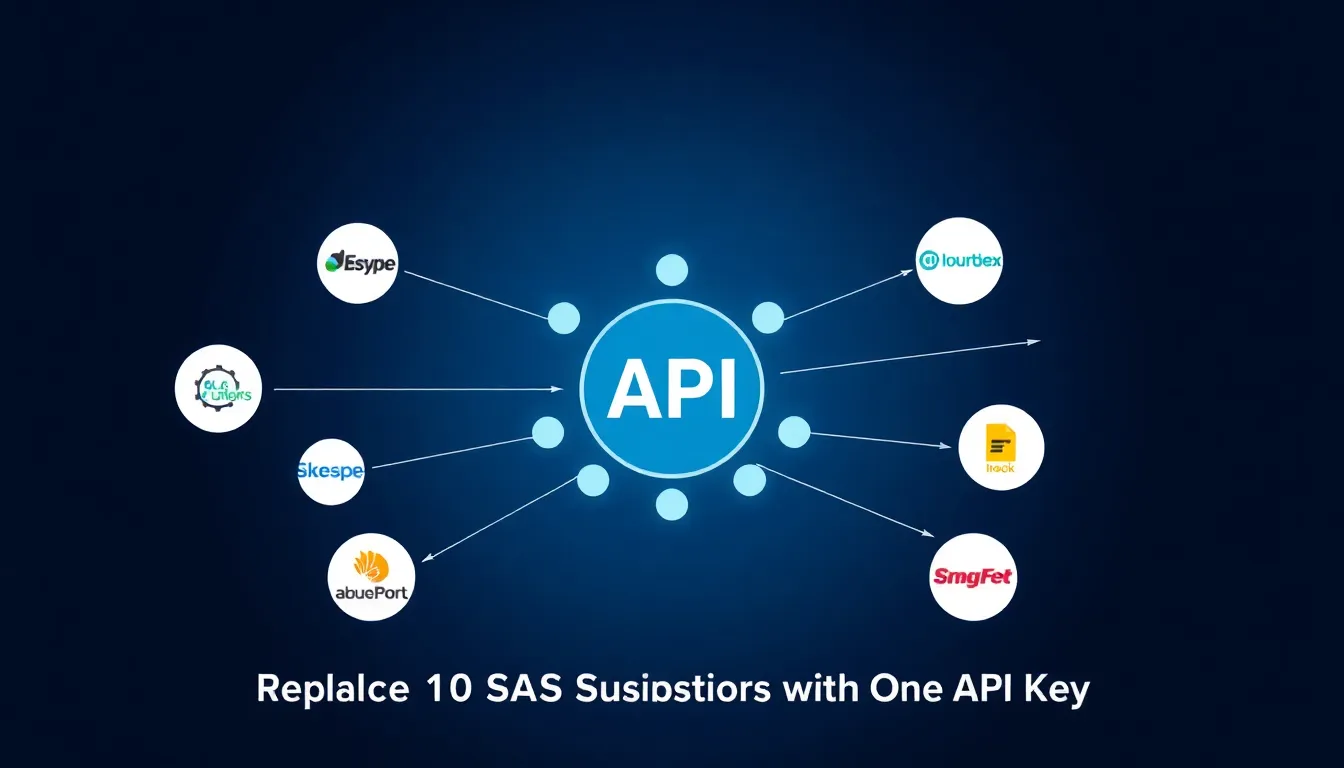
Monthly SaaS bill: Canva Pro $13 + Hootsuite $99 + ElevenLabs $22 + SocialBlade $20 + Firecrawl $19 + SendGrid $20 + various AI models $50-200. Total: $243-593/month. 10 different dashboards, 10 different logins, 10 different billing cycles.
One SkillBoss account. One API key. One bill. Pay only for what you use. Total cost for the same capabilities: $20-80/month depending on usage. 697 endpoints, 63 vendors, zero vendor management.
The modern business landscape has created what industry experts call "SaaS sprawl" - the uncontrolled proliferation of software-as-a-service tools across organizations. What starts as a simple need for email marketing quickly snowballs into a complex web of interconnected subscriptions, each addressing a specific business function but creating operational chaos in the process.
Every business function has been carved into specialized niches, each dominated by dedicated SaaS providers. Social media analytics? That's one subscription with companies like SocialBlade or Hootsuite Analytics. Image generation and editing? Another subscription through services like Canva Pro or Adobe Creative Suite. Email marketing requires platforms like Mailchimp or ConvertKit. Web scraping needs tools like ScrapingBee or Apify. Customer relationship management demands Salesforce or HubSpot. Project management requires Asana or Monday.com. Each solution costs anywhere from $10 to $100+ per month, and most impose strict usage limits that force upgrades as your business grows.
The subscription model has fundamentally changed how businesses approach software procurement. Instead of making large upfront investments in comprehensive solutions, companies now find themselves paying recurring monthly fees that compound over time. A typical small business uses 87 different SaaS applications on average, while enterprise companies often exceed 300 different tools. These subscriptions don't just represent financial costs - they create integration nightmares, data silos, and administrative overhead that consumes valuable time and resources.
The psychological trap of SaaS subscriptions lies in their incremental adoption. Each new tool seems reasonable in isolation - "it's just $29 per month" - but the cumulative effect creates substantial financial burden. Businesses often discover they're spending more on monthly subscriptions than they would on hiring additional staff. The subscription model also creates vendor lock-in scenarios where switching costs become prohibitively high due to data migration complexity and workflow dependencies.
Beyond the financial implications, multiple subscriptions create operational inefficiencies that impact productivity and decision-making. Teams spend hours manually transferring data between systems, creating custom integrations that break when APIs change, and managing user access across dozens of platforms. The cognitive load of context-switching between different interfaces and workflows reduces overall efficiency, while inconsistent data formats and update cycles create information gaps that hurt business intelligence efforts.
The concept of consolidating multiple SaaS subscriptions through a single API represents a paradigm shift from fragmented point solutions to unified platform access. SkillBoss consolidates 697 endpoints from 63 vendors into one comprehensive API, effectively replacing entire categories of business software with programmatic access to the same underlying functionality.
Social Media Analytics and Management represents one of the largest categories of replaceable subscriptions. Instead of paying for SocialBlade Pro ($3.99/month), Hootsuite Analytics ($99/month), or Sprout Social ($249/month), businesses can access TikTok analytics, social insights, YouTube statistics, Twitter metrics, and social page data through unified endpoints. These APIs provide the same data that powers expensive dashboard subscriptions - follower growth rates, engagement metrics, competitor analysis, and content performance tracking - but with the flexibility to integrate directly into existing business intelligence systems.
Content Creation and Media Processing subscriptions can be entirely replaced through API access. Services like Canva Pro ($12.99/month), Adobe Creative Cloud ($52.99/month), or specialized tools like Unsplash+ ($10/month) for stock photos become unnecessary when you can programmatically access image generation APIs, photo editing endpoints, and vast media libraries. Background removal, image resizing, format conversion, logo creation, and even AI-powered design generation become available through simple API calls rather than expensive monthly subscriptions.
Communication and Marketing Automation tools represent another major category of replaceable subscriptions. Email marketing platforms like Mailchimp ($10-300/month), SMS services like Twilio ($20+/month), and WhatsApp Business API access can all be consolidated. Instead of managing separate dashboards and learning different interfaces, businesses can integrate email campaigns, SMS notifications, and WhatsApp messaging directly into their existing systems through unified API endpoints.
Data Collection and Web Intelligence subscriptions often represent the highest monthly costs for data-driven businesses. Web scraping tools like ScrapingBee ($29-249/month), Apify ($49-499/month), or Bright Data ($500+/month) become redundant when comprehensive scraping APIs are available. These endpoints provide access to e-commerce data, social media content, news articles, financial information, and competitor intelligence without the overhead of managing separate scraping infrastructure.
Business Intelligence and Analytics platforms can be partially or entirely replaced depending on specific needs. Tools like SEMrush ($119.95/month), Ahrefs ($99-999/month), or SimilarWeb ($249/month) provide valuable data, but their core functionality - keyword research, backlink analysis, traffic estimation, and competitor monitoring - can be accessed through API endpoints and integrated into custom dashboards that provide exactly the metrics your business needs without paying for unused features.
The mathematical impact becomes clear when calculating total subscription costs across these categories. A typical growing business might pay $99 for social media management, $53 for creative tools, $79 for email marketing, $149 for web scraping, and $199 for SEO analytics - totaling $579 monthly before considering usage overages, additional user seats, or premium features that often double these base costs. Based on reviews from G2 that this approach delivers measurable improvements in efficiency and cost reduction.
Understanding the true cost of SaaS subscriptions requires looking beyond advertised base prices to include usage overages, additional user seats, premium features, and hidden fees that accumulate over time. Most SaaS providers use tiered pricing models designed to encourage upgrades, with strict limits that growing businesses quickly exceed.
Individual subscriptions for comprehensive business functionality typically range from $243 to $593 per month minimum, assuming base-tier plans across major categories. Social media management tools like Hootsuite start at $49/month but limit social profiles and scheduled posts, forcing upgrades to $129/month for meaningful business use. Email marketing platforms like Mailchimp appear affordable at $10/month for 500 contacts, but pricing escalates to $299/month for 10,000 contacts with automation features. Web scraping services like ScrapingBee begin at $29/month for 100,000 API calls, but realistic business usage often requires $149/month plans for 2 million calls.
The subscription cost escalation becomes more dramatic when factoring in realistic usage patterns. A growing e-commerce business might start with basic plans totaling $200/month, but within six months find themselves paying $800+/month as they exceed contact limits, require additional integrations, and need premium features. Annual contracts, often required for meaningful discounts, lock businesses into costly commitments that become even more expensive if usage patterns change or business needs evolve.
Pay-per-call API pricing fundamentally changes this cost structure by eliminating fixed monthly minimums and allowing businesses to pay only for actual usage. SkillBoss pricing ranges from $0.001 to $0.73 per API call depending on the service complexity, with most typical business intelligence calls costing $0.01-0.05. This means 10,000 social media analytics calls - equivalent to comprehensive monthly reporting for multiple profiles - costs $100-500 rather than $99-249 in monthly subscription fees.
The cost advantage becomes even more significant for businesses with variable or seasonal usage patterns. A retail business might need intensive social media analytics during holiday seasons but minimal monitoring during slow periods. Subscription models force payment for peak capacity year-round, while API pricing scales naturally with actual business needs. A company requiring 50,000 API calls during peak months and 5,000 during slow periods pays proportionally rather than maintaining expensive subscriptions for unused capacity.
Beyond direct cost savings, API access eliminates numerous hidden expenses associated with SaaS subscriptions. Integration costs disappear when all data flows through a single API rather than requiring custom connections between multiple platforms. Training costs reduce significantly when teams work with unified endpoints rather than learning separate interfaces for each tool. Administrative overhead decreases when managing one API key instead of dozens of subscription accounts with different billing cycles, user management systems, and renewal dates.
The total cost of ownership calculation reveals even greater savings when factoring in operational efficiency gains. Teams that spend 10 hours weekly managing multiple SaaS platforms, transferring data between systems, and reconciling different reporting formats can redirect that time to revenue-generating activities. At a loaded hourly rate of $75 for technical staff, this represents $3,000 monthly in opportunity cost reduction beyond direct subscription savings. Research from Forrester indicates that this approach delivers measurable improvements in efficiency and cost reduction.
Managing multiple SaaS subscriptions manually represents one of the most time-consuming and error-prone approaches to business operations, yet it remains the default method for most growing companies. The manual process begins with subscription procurement, where different team members independently sign up for tools they need, creating an uncontrolled sprawl of accounts across corporate credit cards and email addresses. IT departments often discover unauthorized subscriptions months later during expense reviews, by which time teams have become dependent on tools that may violate security policies or create compliance risks.
The daily operational burden of manual SaaS management becomes apparent in routine tasks that should be automated but require constant human intervention. Social media managers log into separate platforms to gather analytics data, manually export CSV files with incompatible formats, and spend hours consolidating information into unified reports. Marketing teams copy contact lists between email platforms and CRM systems, manually ensuring data consistency while introducing human errors that corrupt customer records. Web scraping operations require constant monitoring across different tools, each with unique interfaces and data export processes that demand specialized knowledge.
Data synchronization represents perhaps the most challenging aspect of manual SaaS management. Customer information exists in fragmented silos across multiple platforms, with no automated method to ensure consistency or accuracy. Sales teams update lead information in the CRM while marketing teams modify the same contacts in email platforms, creating data conflicts that hurt customer relationships and campaign effectiveness. Project management tools contain task information that doesn't sync with time tracking systems, forcing manual reconciliation for accurate billing and resource planning.
The cognitive overhead of context switching between multiple SaaS platforms significantly impacts productivity and decision-making quality. Teams spend substantial mental energy remembering different login credentials, navigating unique interfaces, and adapting to varying data formats and terminology. A typical marketing analyst might start the day in Google Analytics, switch to SEMrush for keyword research, move to Hootsuite for social media metrics, then compile everything in Excel or Google Sheets. Each platform transition requires mental adjustment and increases the likelihood of errors or missed insights.
Manual subscription management also creates substantial administrative burdens that consume valuable leadership time. Finance teams must track billing cycles across dozens of different vendors, each with unique pricing models, renewal dates, and contract terms. Procurement processes become complex when evaluating overlapping functionality between tools, determining which subscriptions provide genuine value versus redundant features. User access management becomes a nightmare when employees join or leave the company, requiring updates across potentially hundreds of different accounts and platforms.
The security and compliance implications of manual SaaS management create additional risks that many businesses underestimate. Shadow IT emerges when teams sign up for tools without proper security review, potentially exposing sensitive data through inadequately secured platforms. Password management becomes increasingly difficult as teams struggle to maintain unique, strong credentials across multiple platforms, often resorting to password reuse that creates security vulnerabilities. Data governance becomes nearly impossible when customer information is scattered across platforms with different privacy policies and data handling practices.
Enterprise-grade all-in-one SaaS platforms promise to solve subscription sprawl by consolidating multiple business functions into comprehensive suites, but they introduce their own set of challenges related to cost, flexibility, and vendor lock-in. These platforms typically target larger organizations with substantial budgets and complex requirements, making them expensive and often over-engineered for growing businesses that need specific functionality without paying for unused features.
HubSpot represents one of the most popular all-in-one solutions, combining CRM, email marketing, social media management, content management, and analytics into a unified platform. Pricing starts at $45/month for basic CRM functionality but quickly escalates to $800/month for Marketing Hub Professional and $1,200/month for Enterprise features. While HubSpot provides seamless integration between functions, businesses often find themselves paying for extensive functionality they don't need while still lacking specialized capabilities that require additional third-party integrations. The platform's strength in marketing automation may come with weaker social media analytics compared to specialized tools, forcing compromises in functionality.
Salesforce offers perhaps the most comprehensive business platform available, with modules for sales, marketing, customer service, analytics, and custom application development. However, Salesforce's complexity and cost structure make it prohibitive for many businesses. Essential functionality starts at $25/user/month but realistic business implementations often require multiple clouds costing $150-300/user/month. Implementation and customization costs frequently exceed annual subscription fees, with businesses spending $50,000-500,000 on initial setup and ongoing customization. The platform's power comes with steep learning curves that require dedicated administrators and extensive training investments.
Microsoft 365 Business Premium provides an alternative approach by combining productivity tools with business applications. At $22/user/month, it includes email, document collaboration, basic CRM functionality, and simple automation tools. However, the platform's strength in productivity comes with weaker specialized functionality for areas like social media management, advanced analytics, or web scraping. Businesses often find they still need additional subscriptions for core functions, making the all-in-one promise incomplete while adding Microsoft's tools to their existing stack.
Zoho One takes a different approach by offering over 45 integrated applications for $37/user/month, making it one of the most cost-effective all-in-one solutions available. The platform includes CRM, email marketing, project management, accounting, HR tools, and custom application development. However, individual Zoho applications often lack the depth and sophistication of specialized competitors. The email marketing functionality may be adequate but doesn't match Mailchimp's automation capabilities, while the social media tools provide basic scheduling without the analytics depth of dedicated platforms.
The fundamental limitation of all-in-one platforms lies in their inability to be best-in-class across all functional areas. Software development resources are finite, and platforms that attempt to address everything often excel at nothing. A company that chooses HubSpot for its excellent inbound marketing capabilities may find its social media analytics lacking compared to specialized tools. Businesses using Salesforce for its powerful CRM features might discover its email marketing functionality doesn't match dedicated platforms like Mailchimp or ConvertKit.
Vendor lock-in represents another significant risk with all-in-one platforms. Once business processes and data are deeply integrated into a comprehensive platform, switching costs become enormous. Data migration challenges, workflow recreation, and team retraining can cost tens of thousands of dollars and months of disruption. This dependency gives vendors substantial pricing power over time, with businesses often facing steep price increases during renewal negotiations when switching isn't realistic. The promise of integration convenience becomes a trap that limits future flexibility and innovation.
The SkillBoss approach fundamentally reimagines how businesses access software functionality by providing programmatic access to 697 endpoints from 63 vendors through a single API key. This method eliminates the traditional distinction between different SaaS platforms by treating all business functions as API calls that can be integrated directly into existing workflows, custom applications, or business intelligence systems. Instead of managing multiple subscriptions with different interfaces and data formats, businesses interact with all services through consistent REST API endpoints that return standardized JSON responses.
The technical implementation begins with a single API key that provides authenticated access to the entire SkillBoss ecosystem. Developers can immediately start making calls to social media analytics endpoints, image processing services, email delivery systems, or web scraping tools without separate authentication processes or SDK installations. A typical social media analytics workflow might involve calling GET /api/social/profile/{username}/analytics to retrieve engagement metrics, followed by POST /api/email/send to deliver automated reports to stakeholders. The entire process requires fewer than 10 lines of code compared to managing separate SDKs and authentication systems for multiple vendors.
Data consistency represents one of the most significant advantages of the unified API approach. All endpoints return information in standardized formats with consistent field names, data types, and error handling. Social media follower counts use the same JSON structure whether retrieved from social, TikTok, or YouTube APIs. Image processing results follow identical patterns regardless of whether you're removing backgrounds, resizing images, or generating thumbnails. This consistency eliminates the data transformation overhead that consumes significant development time when integrating multiple vendor APIs directly.
The cost model alignment with actual usage creates substantial advantages for businesses with variable or unpredictable requirements. E-commerce companies can scale social media monitoring during product launches without maintaining expensive monthly subscriptions for peak capacity. Seasonal businesses pay proportionally for increased analytics during busy periods while minimizing costs during slow months. Development teams can experiment with new functionality through small API call volumes before committing to larger implementations, reducing the risk of expensive subscription commitments for unproven use cases.
Real-world implementation examples demonstrate the practical advantages of consolidated API access. A digital marketing agency managing 50 client social media accounts might make 10,000 analytics calls monthly across social, TikTok, and YouTube endpoints. Using SkillBoss, these calls cost approximately $100-500 depending on complexity, compared to $200-400 monthly for basic social media management subscriptions that often limit the number of managed profiles. The API approach also enables custom reporting dashboards that combine social media metrics with email campaign performance and web analytics in ways that separate SaaS platforms cannot achieve.
Advanced automation becomes possible when all business functions are accessible through consistent API endpoints. Businesses can create sophisticated workflows that automatically scrape competitor pricing data, generate comparative analysis reports, and distribute insights through email or messaging APIs. Image processing can be triggered automatically when new product photos are uploaded, with results integrated directly into e-commerce platforms or marketing materials. Social media performance can trigger automated email campaigns or adjust advertising spend based on engagement metrics, creating responsive marketing systems that adapt to real-time data.
The development and maintenance overhead reduction becomes significant when managing a single API integration instead of multiple vendor relationships. Code complexity decreases when all external services follow identical authentication patterns, error handling, and response formats. Documentation overhead reduces from managing dozens of different API specifications to understanding one comprehensive system. Monitoring and debugging become simpler when all external service calls flow through a single integration point rather than tracking issues across multiple vendor APIs with different logging and error reporting systems.
The decision to consolidate SaaS subscriptions through API access requires careful evaluation of specific business conditions, technical capabilities, and cost thresholds that determine when the transition provides meaningful advantages. Not every business is ready for API-first approaches, and timing the switch correctly can mean the difference between successful optimization and operational disruption.
Financial Threshold Analysis provides the most objective criteria for evaluating consolidation timing. Businesses spending more than $300 monthly on SaaS subscriptions across multiple categories typically reach the break-even point where API consolidation provides immediate cost savings. However, the real financial benefit emerges above $500 monthly in subscriptions, where pay-per-call pricing often reduces costs by 40-60% while eliminating usage restrictions that force expensive plan upgrades. Companies approaching $1,000 monthly in SaaS costs should prioritize API consolidation as a strategic cost management initiative that can free up substantial budget for growth investments.
Technical Readiness Assessment determines whether organizations have the infrastructure and expertise to successfully implement API-first approaches. Companies with dedicated development resources or technical team members comfortable with REST APIs can typically implement consolidation within 2-4 weeks. However, businesses relying entirely on non-technical staff for software management may need to invest in training or contractor support before attempting the transition. The presence of existing custom applications, business intelligence systems, or automation workflows often indicates sufficient technical sophistication to benefit from API access.
Operational Complexity Indicators signal when SaaS sprawl has reached problematic levels that justify consolidation efforts. Teams spending more than 10 hours weekly on manual data transfers between platforms, struggling with inconsistent reporting across tools, or frequently encountering integration limitations should prioritize API consolidation. The presence of "shadow IT" subscriptions that teams have adopted independently often indicates systematic problems that comprehensive API access can address more effectively than additional SaaS procurement controls.
Growth Stage Considerations influence optimal timing for API adoption. Early-stage companies with limited technical resources may benefit from delaying consolidation until they have clearer usage patterns and sufficient development capabilities. However, rapidly growing businesses that are adding new SaaS subscriptions monthly should consider API consolidation before reaching unsustainable complexity levels. Companies preparing for funding rounds or acquisition often find that demonstrating efficient, scalable operations through API consolidation improves their attractiveness to investors or acquirers.
Data Integration Requirements provide strong indicators for API consolidation timing. Businesses needing real-time data synchronization between multiple platforms, custom reporting that combines information from various sources, or automated workflows that span multiple services should prioritize API access. The presence of manual processes that could be automated through programmatic access to business functions often justifies immediate consolidation regardless of other factors.
The decision framework should also consider competitive advantages that API consolidation can provide. Companies in data-driven industries where faster insights or more comprehensive analytics provide market advantages should move quickly to API-first approaches. Businesses competing on operational efficiency, customer experience customization, or rapid feature development often find that API consolidation enables capabilities that SaaS-dependent competitors cannot match. The ability to create unique competitive advantages through custom integrations and automation often outweighs pure cost considerations in strategic decision-making.
List every SaaS tool you're paying for. Note the monthly cost and which API/feature you actually use from each.
For each tool, find the corresponding SkillBoss endpoint. Most have direct equivalents. Some have better alternatives you didn't know existed.
Don't cancel everything at once. Replace one tool per week. Verify it works. Then cancel the old subscription. In 2 months, your SaaS bill drops by 60-80%.
SkillBoss provides an OpenAI-compatible API. Switch models by changing the model name — no new API keys needed.
api.skillboss.co/v1
Switch between 100+ models instantly.
curl https://api.skillboss.co/v1/chat/completions \
  -H "Authorization: Bearer $SKILLBOSS_API_KEY" \
  -H "Content-Type: application/json" \
  -d '{
    "model": "deepseek/deepseek-chat",
    "messages": [{"role": "user", "content": "Hello!"}]
}'SkillBoss maintains the integrations. If an underlying vendor changes their API, SkillBoss adapts. Your code stays the same.
No. Pure pay-as-you-go. If you use nothing in a month, you pay nothing. $10 minimum top-up when adding credit.
SkillBoss covers 697 endpoints across 63 vendors. Check their docs for specific tools. They add new integrations regularly.
Yes. SkillBoss has an MCP integration for Claude Code, OpenClaw, Cursor, and other AI tools. Your agent can access all 697 endpoints through natural language.
Pre-funded account. Top up with $10+. Each API call deducts from your balance. Dashboard shows real-time usage by endpoint.
697 endpoints. 63 vendors. One API key. $2 free credit to start.
AI Agents
Tell your agent:
set up skillboss.co/skill.mdAuto-configures base URL, auth, and model access. Works with Claude Code, Cursor, Windsurf, and any MCP-compatible agent.
Developers
Sign up and get your API key in 60 seconds. $2 free credit included.
Sign Up Free →Pay-as-you-go · No subscription · Credits never expire
